
Equations in E Minor -Dentaku San’s Calculator Synth Music
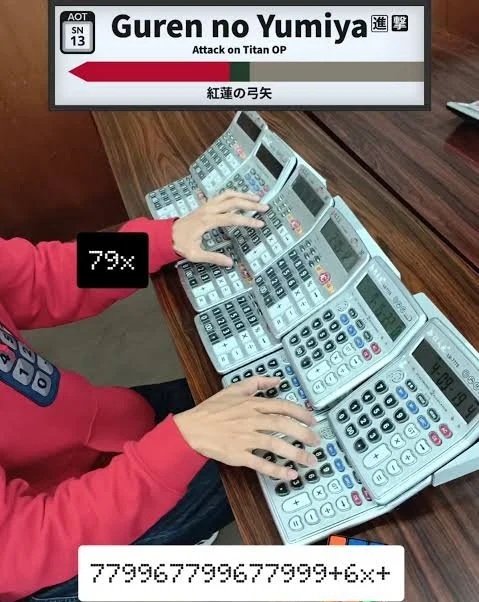
8-bit covers of your favourite anime soundtracks have become a subgenre in their own right. From Evangelion to Chainsaw Man, whatever the series, chances are there’s an 8-bit version floating around somewhere online. Far rarer, however, are live performances of these chiptune arrangements.
Hailing from the musical city of Hamamatsu, Dentaku-san turned a collection of calculators into a makeshift synth rack to deliver exactly that. The Chinese-manufactured AR-7778 calculator features a built-in music mode, effectively transforming it into a miniature synthesiser. Because each calculator can only play one diatonic note at a time, and therefore cannot produce chords on its own, he combined multiple calculators into a full keyboard setup, allowing him to perform live covers of beloved anime soundtracks and more.
We spoke with Dentaku-san to learn how this niche obsession evolved into one of the internet’s distinctive musical performances.
How did you come up with the idea of combining multiple calculators and playing them together like a single keyboard?
I wasn’t actually the first person to start performing with calculators. I came across a video of someone playing with around four calculators, and I thought it looked really interesting, so I decided to try it myself. At first, I also performed using about four calculators, but I became frustrated because it was difficult to play three- or four-note chords like you can on a piano. Compared to the piano, the sound lacked depth.
The reason is simple: each calculator can only produce one note at a time. Even if you line them up horizontally, your fingers can only comfortably reach two calculators, meaning you can only play two-note chords. Physically, anything beyond that wasn’t possible.
But I really wanted to play three- and four-note chords like on a piano. That’s when I realized that if I arranged the calculators not only side by side but also vertically, I might be able to press three or four calculators simultaneously with one hand.
There was another limitation as well. A single calculator cannot produce chromatic notes, it only plays a whole-tone scale. To perform chords in different keys, you need two types of calculators that are tuned a semitone apart. These calculators naturally vary slightly in pitch from unit to unit.
While struggling with these limitations, and sometimes even enjoying them, I kept experimenting with the layout like solving a puzzle. Through countless rounds of trial and error, I gradually added more calculators until I eventually arrived at my current setup of twelve.
I imagine it must have taken an incredible amount of practice before you could perform on multiple calculators simultaneously.
I studied piano when I was younger. To reach a point where playing the calculators felt somewhat similar to playing the piano, I basically relied on endless repetition.
With my right hand, I generally play the melody using two calculators, one of each type, tuned a semitone apart.
Because the layout is completely different from a piano keyboard, it was incredibly difficult at first. It honestly felt like my brain was going to break. But I had a strong desire to be able to play, so I simply kept practicing the songs I wanted to perform over and over again.
Gradually, I developed an intuitive feel for the calculator’s unique layout, and now I can play melodies with a sensation that’s fairly close to playing the piano.
With my left hand, I mainly use eight calculators to play chords.
In the beginning, every time I encountered a new chord in a song, I had to figure out, almost like solving a puzzle, which button on which calculator I needed to press. I wrote everything down and drilled it into both my mind and my fingers through constant repetition.
Now, the positions of many chords have become second nature. As long as I learn the chord progression and practice a little, I can perform most songs reasonably well.
I understand that you’re from Hamamatsu, a city often regarded as one of Japan’s great centers of music. What does Hamamatsu mean to you, both personally and in your musical career?
I started learning piano when I was very young, so I’ve always grown up surrounded by music. Whenever you walk around town or attend local events, you hear brass bands, live bands, and all kinds of musical performances. It’s a city with many people who genuinely love music.
Growing up in that environment has made me want to give something back to Hamamatsu. By performing with calculators and helping bring excitement to the city, I hope I can contribute to my hometown in some small way. That desire has become one of my biggest motivations for continuing my musical activities.
Someday, I’d love to perform together with someone who was inspired to start playing calculator music after watching my performances.
I’d also love for the piano teacher who taught me as a child to hear my calculator performances someday.
Trending articles


What happens when your memories look stranger than reality itself?