
LITTERED MVMNTS -Shoji Yamasaki and the Choreography of What We Throw Away
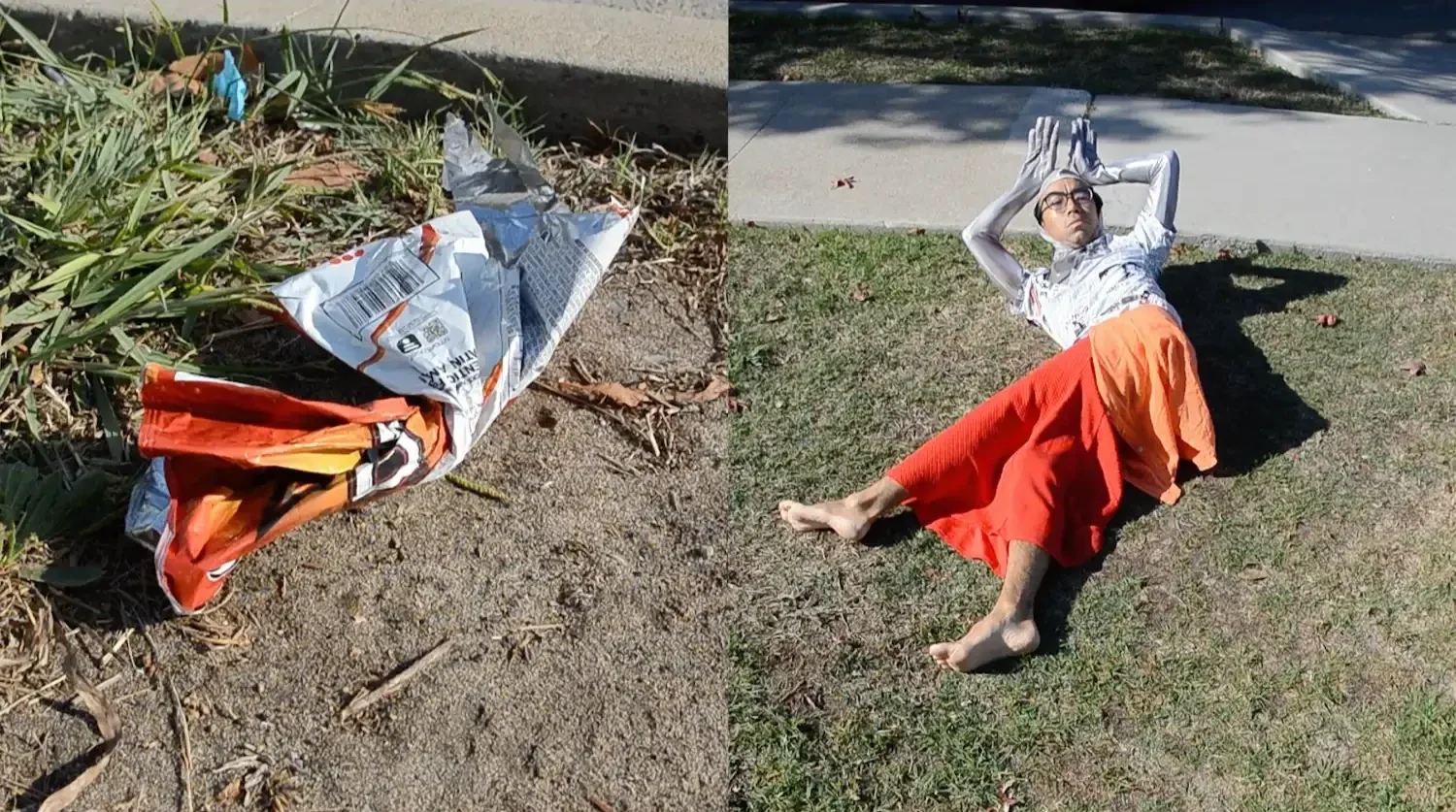
© Shoji Yamasaki
Most of us have become pretty unsensitized when it comes to spotting trash in the streets of our cities. Have you ever stopped in your tracks to watch a Snickers wrapper curl in the wind? Or caught yourself observing an empty bag of Doritos snagged on a branch? And eventually pick it up? For Shoji Yamasaki, this became a ritual. Before he was the one mimicking those unreliable movements, he was the one haunting them, documenting the jagged physics of the things we discard.
His project, LITTERED MVMNTS is a study of the junk we ignore, re-contextualized through a lens that feels both deeply human and unsettlingly alien. While the digital landscape tries to categorize his work as "satisfying" choreography, there is a structuralist grit beneath the surface. These aren't lucky breaks or viral flukes; they are the result of hours spent in the dirt during the pandemic’s peak, a time when the traditional stage evaporated, leaving only the sidewalk and the breeze to work with.
The work morphed as a series of experiments back at CalArts, but it didn't really find its soul until Yamasaki was forced outside. It’s a project born from the boredom of lockdown and the reality of having nothing but a camera and a gust of wind.
We caught up with Shoji to talk about the "animal logic" of urban debris and how even a piece of trash has a pulse if you watch it long enough.
What was the starting point of LITTERED MVMNTS?
It started around 2021, but at that time I didn’t think of it as anything structured. I had just made this short video, more like a vignette, where I stitched together fragments of trash footage. It wasn’t really planned as a project or an account or anything like that. I wasn’t thinking in terms of social media either. TikTok felt like dances, trends, things happening very fast, and I didn’t see how what I was doing fit into that world at all.
Later on, during my time at CalArts, I started revisiting that material. There was an expo where we had to present work across campus, and I ended up making more pieces, about six videos, all based on trash I found on campus. I was just walking around looking for trash that moved in interesting ways, and filming them as they were.
After I graduated, I suddenly had all this footage sitting on my computer. But it wasn’t really a film yet. It had lived as an installation, not as something linear. So I started thinking about what to do with it. Eventually I cut it down and started posting it, mostly out of curiosity more than intention. That’s when I started experimenting with length, and I realised very quickly that longer formats didn’t really hold the energy. One minute felt too stretched, too soft. So I kept shortening it until I arrived at around fifteen seconds, that felt like the right pressure. Enough time to register something, but short enough that it still behaves like the object itself: quick, unpredictable, gone before you fully process it.
How do you choose what becomes part of a piece?
There’s actually quite a strict process behind it, even if it looks very spontaneous. I don’t pick up everything I see, because if I did, I wouldn’t be able to film at all. It would just become a day of collecting trash instead of observing them.
Usually it goes through a strict audition process. I’m looking for something very specific: it has to be man-made, so no natural objects like leaves or feathers, and it has to have a kind of movement already in it. Wind is usually what activates it, but not always in an obvious way. And then the most important rule is that it needs to stay within a frame long enough, at least fifteen seconds, otherwise there’s no structure to work with.
From there, I record in longer takes, usually around two minutes. I let it run, sometimes multiple times from different angles, and then I go back later to edit everything down. The actual “performance” happens in editing. That’s where I decide which moments actually carry something.
There’s also my body in it, which people don’t always realise. I do everything alone, so I’m constantly checking framing, timing, alignment. I’ll do a countdown before I start, and then I try to match my movement to what I’ve already observed in the trash. Sometimes it takes a long time just to get that alignment right. My head is out of frame, or I’m off by a few seconds, and I have to reset everything. It’s very physical. People see fifteen seconds, but the process behind it takes hours.
You spent years rescuing rabbits. Does that kind of "animal logic" explain why your movements feel so twitchy and reactive?
I rescued rabbits for about fifteen years. It was a huge part of my life. At one point it was just daily care, routine, responsibility. I don’t have them anymore now, mainly because it became too difficult to maintain on a daily basis, but that period shaped how I think about movement.
Rabbits communicate entirely through body language. Ear positions, posture, small shifts in energy. And they also have these movements called binkies, when they’re happy, they jump and twist in mid-air. It’s very expressive, almost like a sudden release of emotion through the body.
As a dancer and choreographer, that stayed with me. I started seeing it less as animal behaviour and more as a kind of language system. Something non-verbal but extremely precise. And over time, I realised I was applying the same way of reading to everything else around me.
That’s where LITTERED MVMNTS comes in. Trash doesn’t communicate in language, but it still behaves. It reacts to wind, gravity, texture, resistance. And I started reading those behaviours in a similar way, not as objects, but as moving systems. Almost like choreography that already exists, and I’m just trying to translate it.
Is stillness part of that language too?
Yes, but I think I’m still figuring that out. Because I also find myself drawn to things that don’t move at all. Like an object that just refuses to respond, a beer bottle or something, no matter how strong the wind is. There’s something interesting in that resistance.
So I don’t know yet if stillness is absence of movement, or just another type of it. That question is still open for me.
Did COVID shift how you see movement?
Completely. During that time, everything I was working on as a dancer stopped. Shows were cancelled, rehearsals disappeared, everything that usually structured my practice just vanished overnight. So I started walking more. Just being outside to clear my mind. And in that space, I became much more aware of small movements around me. Things I would normally ignore.
Trash became part of that. Not in an aesthetic way, but in a behavioural way. Some of it moves aggressively, some barely moves, some feels almost hesitant. And I started noticing those differences the same way I would notice different performers in a room.
There was also something about that period where environmental conversations and behaviours shifted. Suddenly everything was disposable again in a different way. Masks, packaging, single-use everything. It made the presence of waste much more visible in daily life. That stayed with me.
You don’t film where you find the objects. Why is that?
I never go back to the original location. Unless the trash lands around the home. I record everything around the world - LA, Tokyo, Kyoto, Mexico, but I reconstruct the scene at home in LA.
That reconstruction is important. I try to match conditions: light, weather, atmosphere. If I filmed something in sunlight, I wait for a similar light situation. If it was cloudy, I wait for a cloudy day. I check weather forecasts constantly to find the right conditions.
It turns the process into something closer to staging than documentation. But it’s still very minimal. I don’t build sets. I don’t recreate environments artificially. I just use whatever space I already have and try to approximate what I saw.
There’s also a strong material ethics in your process. How intentional is that?
Very intentional. I don’t want to produce new waste through the work itself. That’s a core principle. So I don’t build sets, I don’t destroy objects for the sake of the shot, and I try to reuse or borrow everything involved, clothing, materials, and anything I already have access to. Even costumes are made in a very temporary way, just safety pins and existing fabrics.
And I always pick up the trash after filming. That’s non-negotiable.
There’s also a wider question behind it for me; about how much waste is produced in creative industries in general. Film sets, installations, even short viral content, there’s often a lot left behind. I’m trying to avoid that completely in my own process.
Did your reach on social media change your connection with the art scene?
Not really in those terms. I come from a theatre and choreography background, so I understand that system very well, rehearsals, critique, structure, all of that. But I don’t think about LITTERED MVMNTS as something that needs to sit inside or outside of that. It’s more like a parallel system that borrows the discipline of performance, but compresses it into a different format.
The process is still very structured, research, rehearsal, execution, editing, but the outcome is short. Fifteen seconds instead of an hour-long piece. That difference changes everything, but the internal logic is actually quite similar.
What do you hope people take from it?
I don’t think I can change how the world produces waste. That’s too large. But I do think I can shift how people look at it.
If someone watches a video and suddenly becomes more aware of how trash moves on the street, or even decides to pick it up instead of ignoring it, then that already changes something small in their behaviour.
And for me, that’s enough.
Trending articles

Inside the culture and friendship behind Matthew Ballard’s HIGH RECEIPTS.