
FFFPOSTALSERVICE - On Recon in the Tea Fields of Shizuoka
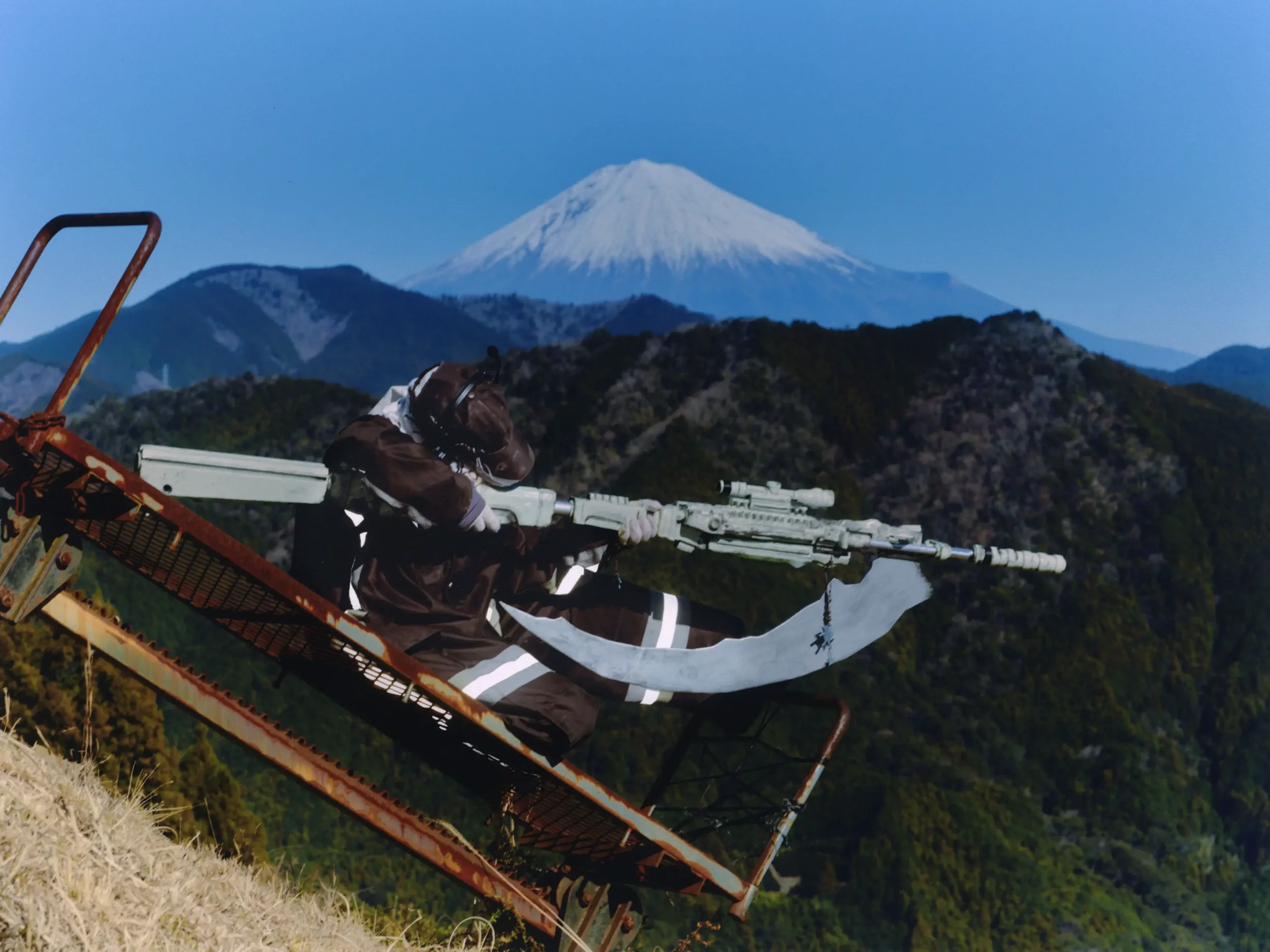
FFFPOSTALSERVICE│photo by Lusan
Different buzzwords come to mind when trying to stick a label on FFFPOSTALSERVICE. Think sci-fi militarism, dystopian, utilitarian, apocalyptic. Yet none of them does the universe created by Jonathan Choe any justice. The Korean brand has never operated as seasonal fashion in the conventional sense. From its earliest graphic experiments, the Korean brand was rooted in sci-fi insignias and imagined military divisions, unfolding into JC’s personal exercise in world-building.
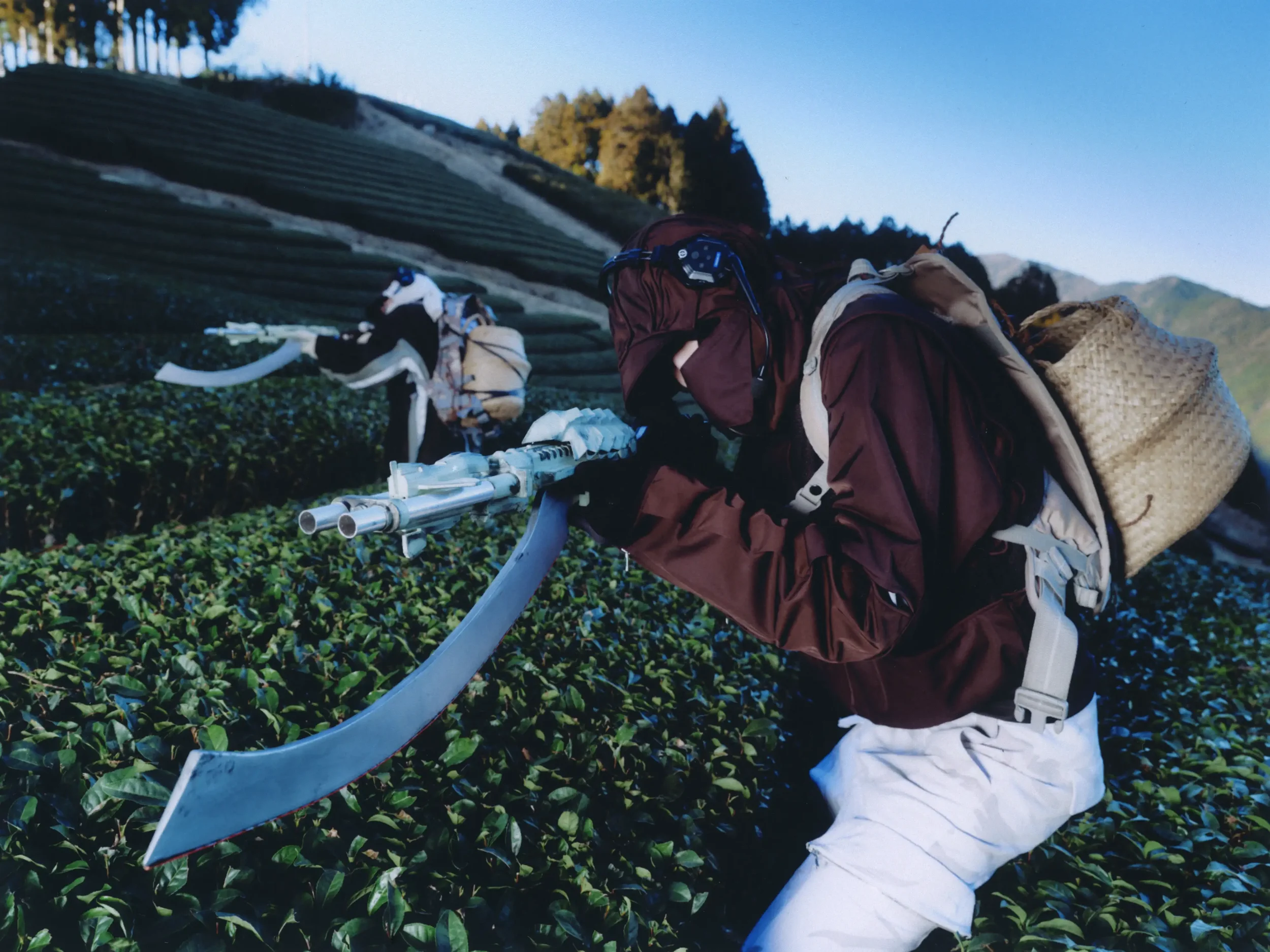
Each collection adds another layer to a universe governed by anonymity, as not fantasy, but a heightened sense of reality shapes the design. PILOT, Choe’s latest collection, makes that philosophy unmistakably clear. Presented at Paris Fashion Week, FFF’s latest collection made its way straight from fashion’s highest institutional framework into a radically different setting: the quiet tea fields of Shizuoka, Japan.
We sat down with founder and creative director Jonathan Choe to talk about his latest collection, what Japanese pop culture has to do with it, and if he is actually shaping the future.
FFFPOSTALSERVICE feels like more than a brand, it feels like a world with its own internal logic. Who is Jonathan Choe within that world?
FFFPOSTALSERVICE is built like a universe, each collection is an episode, each garment a uniform for survival inside that world. Many of the characters I’ve imagined are based on personalities I’ve encountered from childhood until now: ambition, insecurity, hunger, restraint, ego, loyalty. I’ve always been observant. I archive people the way others archive images.
The main protagonist shares traits with me, especially the urge to move fast. There’s a constant momentum. Whether it’s in life, in business, or inside a vehicle, it’s the same instinct. Forward without hesitation.
In this world, I’m not just a designer. I’m both the architect and the test subject. I build the uniform, then I wear it into reality. FFFPOSTALSERVICE is documentation of speed, survival, and evolution.
FFPOSTALSERVICE has evolved over the years, yet its universe feels remarkably consistent. Was this world clear to you from the beginning?
From the beginning, it was intentional. We started with T-shirt graphics rooted in sci-fiction and military symbolism, insignias, coded language, imagined divisions. Even then, it wasn’t just about graphics. It was world-building in fragments.
The end goal was always to create full uniforms, complete looks from top to bottom. Footwear, outerwear, hardware, everything functioning together as one system. What evolved was the execution.
As I gained more access, better fabrics, factories, resources, the world became more dimensional. But the internal logic has always been the same: utilitarian silhouettes, tactical precision, and a sense of futurism grounded in reality.
You’re asked to travel back in time to provide costume design and styling for one movie, which one would you pick?
I would choose Alien.
The original 1979 film feels timeless. The uniforms weren’t flashy or exaggerated, they were functional, believable, lived-in. That’s what made them powerful. It felt like real workers in space, not heroes.
John Mollo did such a beautiful job with the costume design. It would be difficult, almost intimidating, to create something that carries the same cultural weight. But that’s exactly why I would choose it.
What makes Alien special is restraint. The silhouettes were utilitarian. The palette was muted. Everything felt engineered rather than styled. That philosophy aligns deeply with FFFPOSTALSERVICE.
If I were transported back into that production, I wouldn’t try to reinvent it. I would focus on subtle systems, modularity, layered functionality, hidden technical elements that suggest survival beyond what’s seen on screen.
The beauty of Alien is that the uniforms look like they belong to a world that existed before the camera turned on. That’s what I try to do with FFFPOSTALSERVICE, design clothing that feels like it’s part of a larger reality.
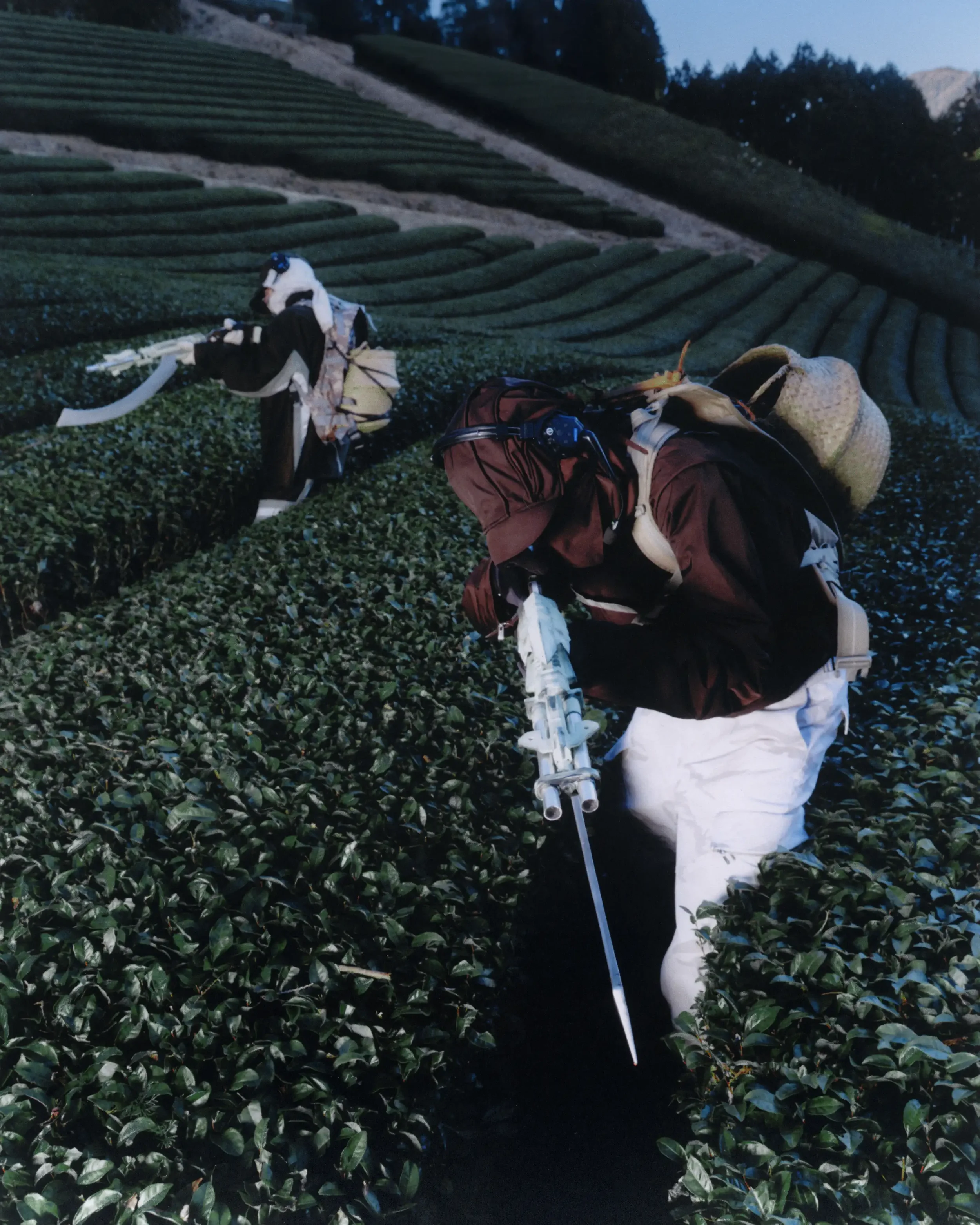
You presented PILOT at Paris Fashion Week, and shortly after placed it in the rural landscape of a Shizuoka tea field. What does that shift say about the world FFFPOSTALSERVICE exists in?
Presenting PILOT during Paris Fashion Week and then placing it in the rural tea fields of Shizuoka was deliberate. Paris is the epicenter of fashion validation. It’s hierarchy, institutions, approval. Showing there proves we can operate inside the system.
Shizuoka proves we don’t need it. FFFPOSTALSERVICE isn’t built for a runway. It’s built as a uniform. If it only works under spotlights, it’s costume. If it works in a silent field with no audience, then it’s real.
The shift says the world of FFFPOSTALSERVICE isn’t tied to geography or industry context. It exists wherever survival exists, in cities, in isolation, in routine, in collapse. Paris was about access. Shizuoka was about autonomy. That contrast defines the brand. We can enter the system. But we don’t depend on it.
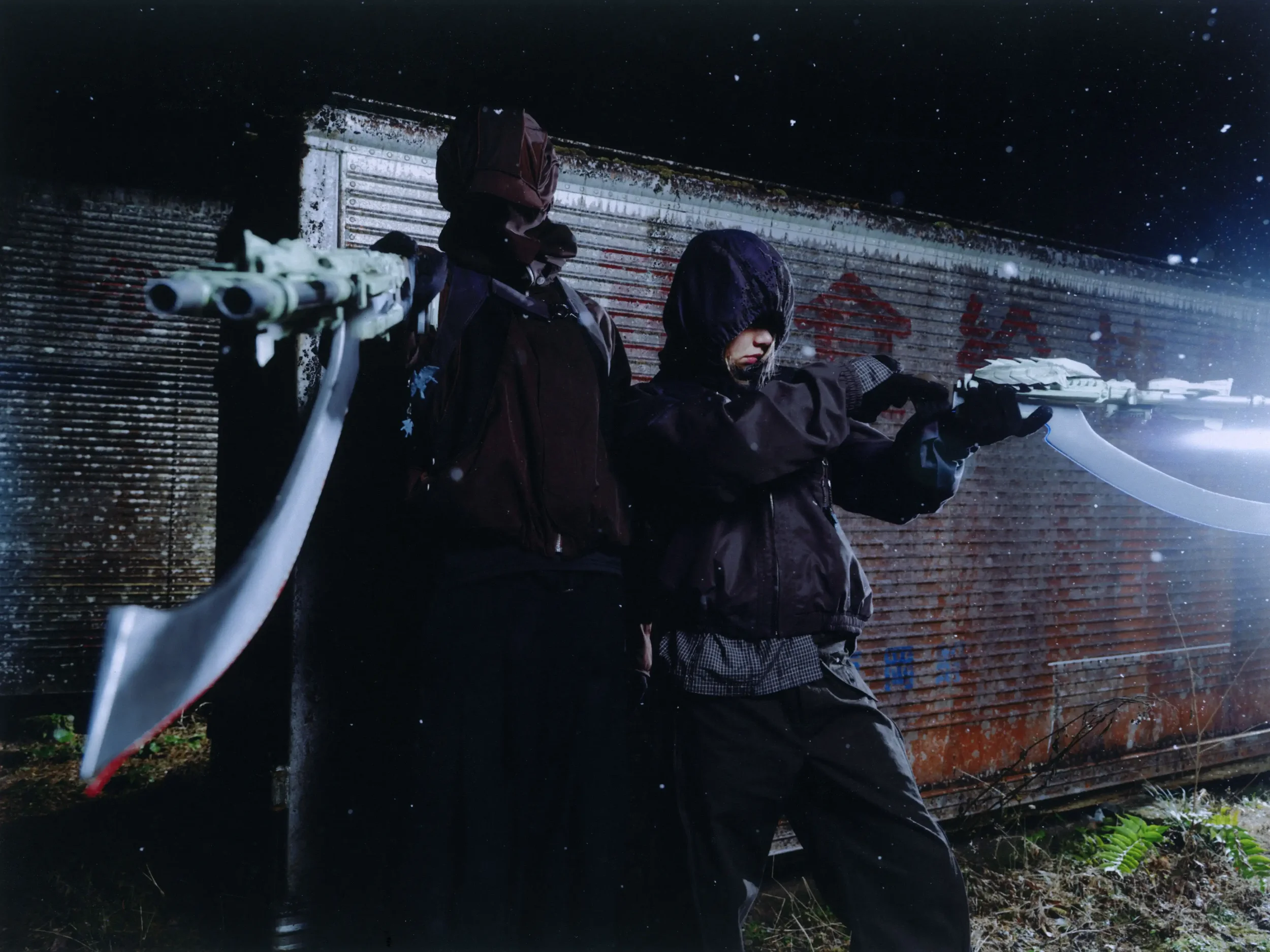
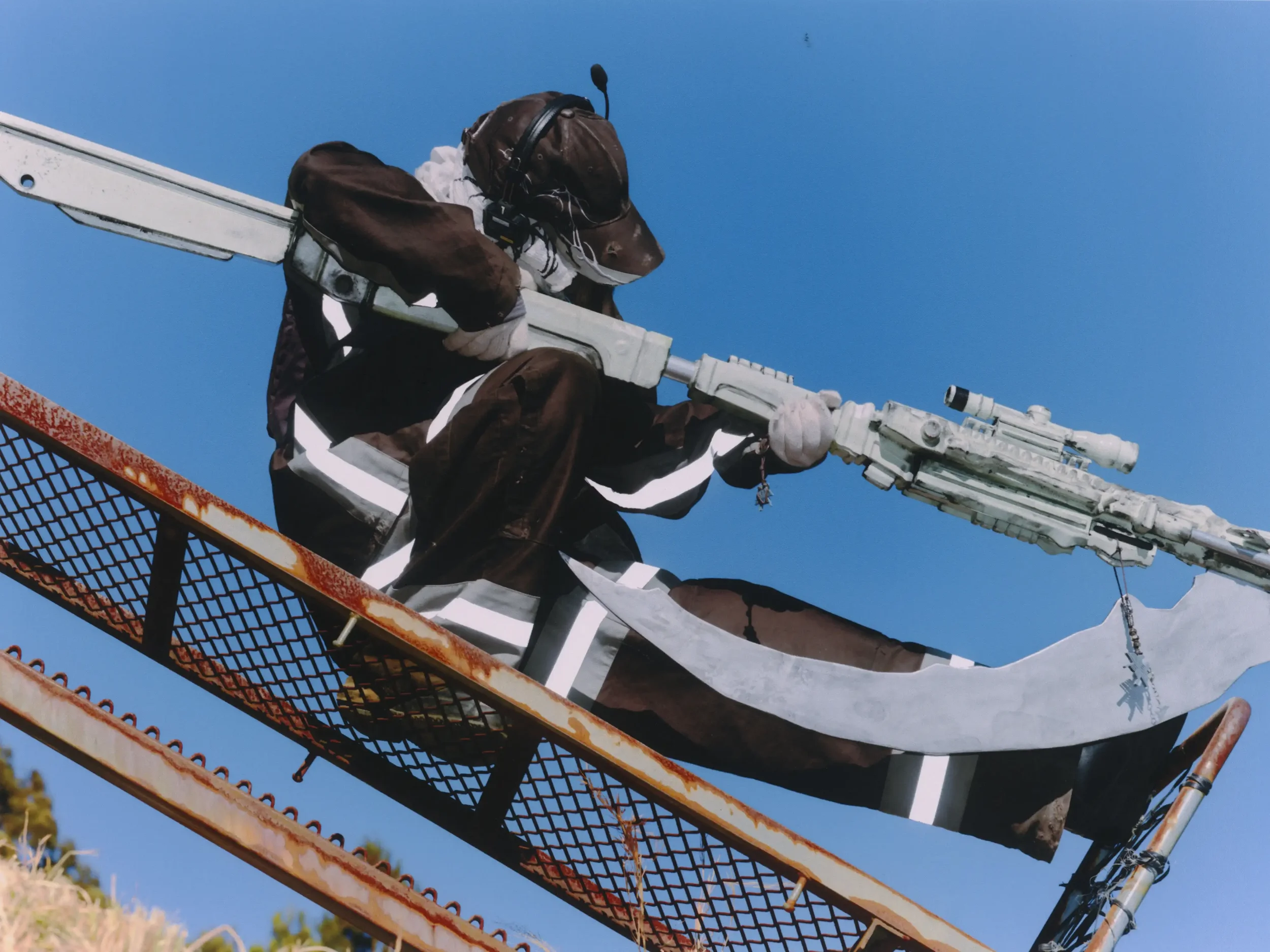
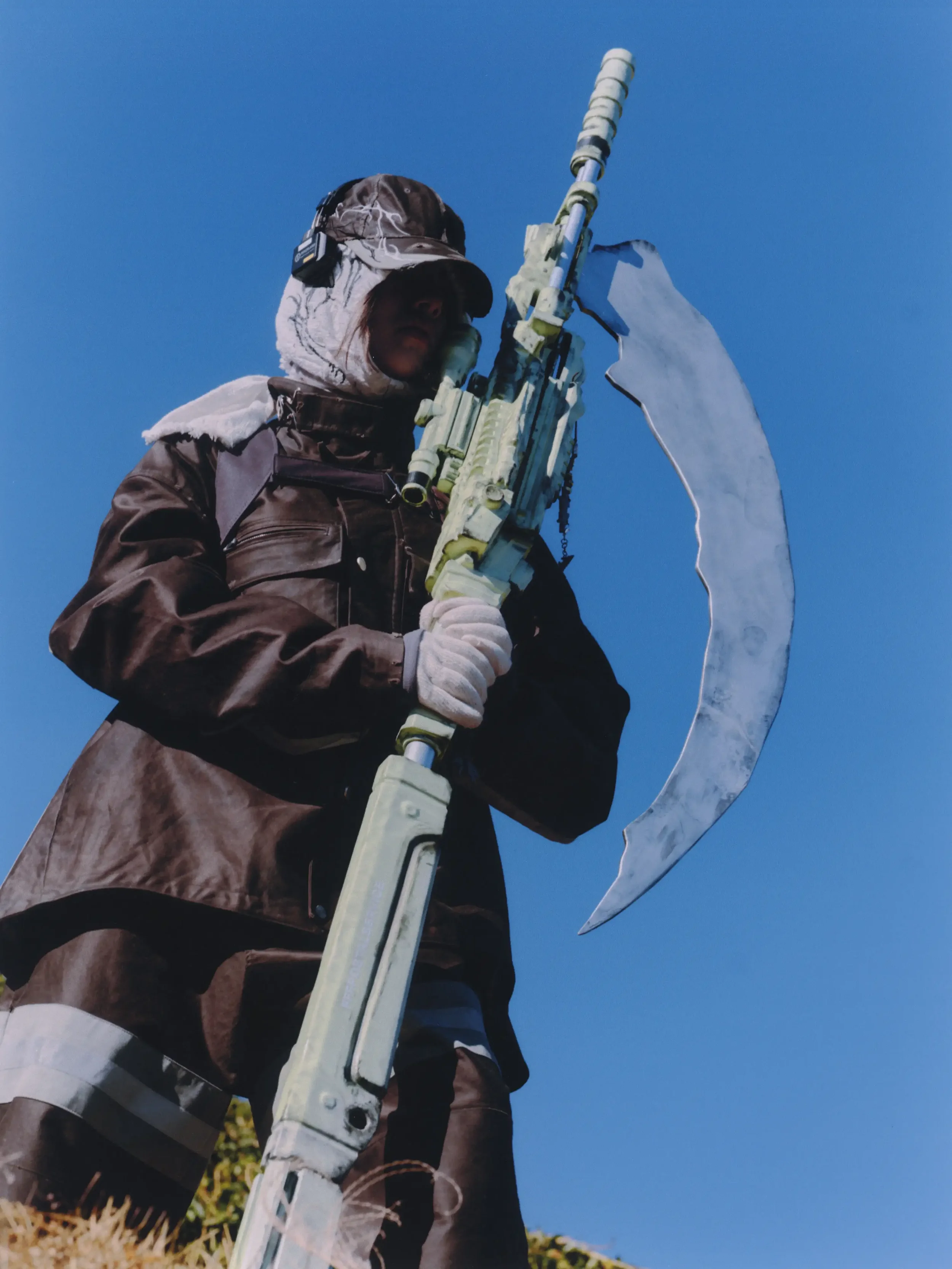
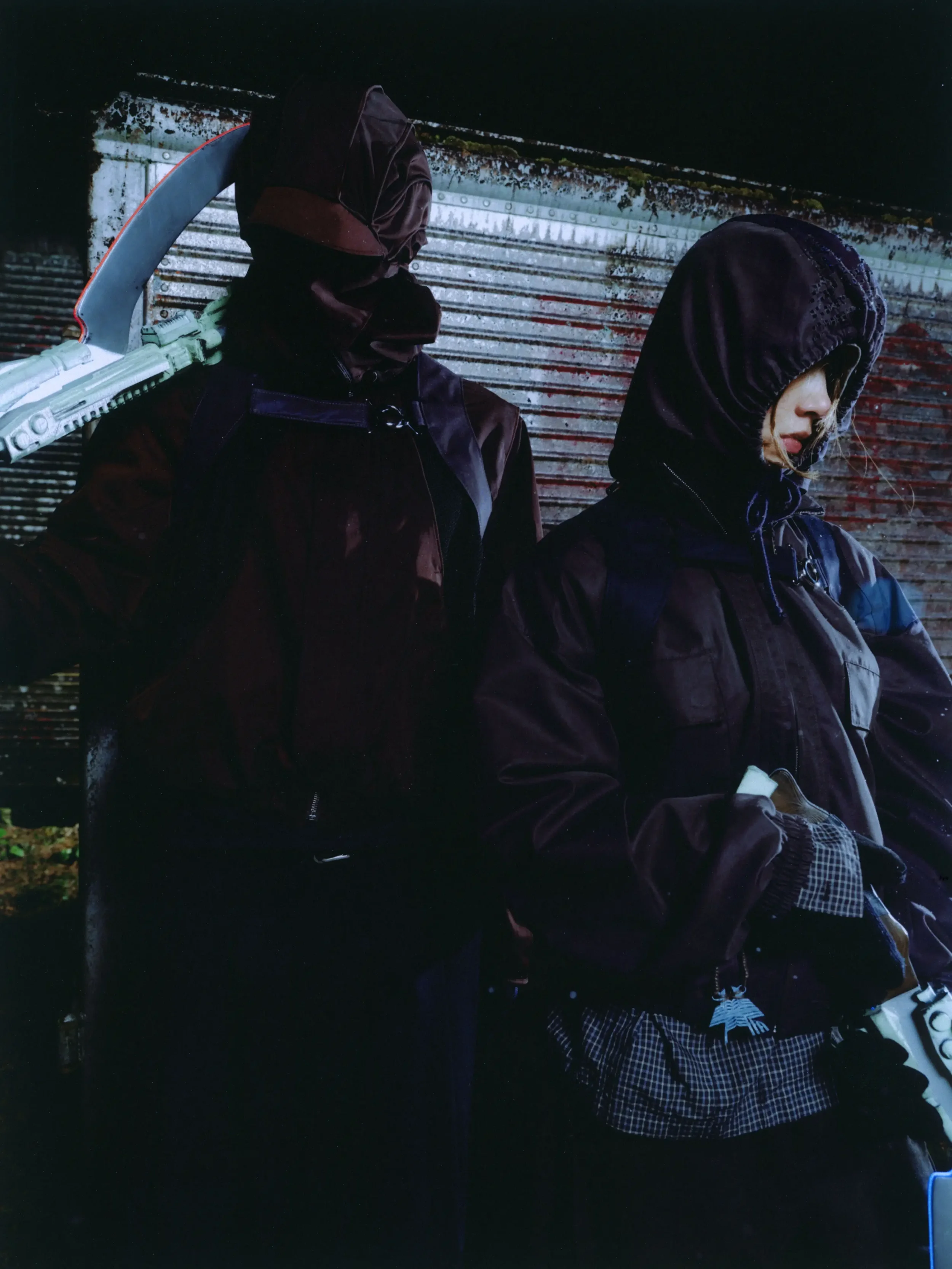
The weapon props come across as ideological objects more than just accessories. They transform your models into a kind of organized resistance. At what point did you decide add these? And are these weapons symbols of protection, aggression, or something else entirely?
The decision to introduce weapon props was all about atmosphere. From early on, FFFPOSTALSERVICE has existed in a slightly distorted version of reality not fantasy, but a heightened state of tension. Adding props helped complete that illusion.
The objects function as supporting elements visual cues that help the viewer understand the psychological environment these uniforms exist in. Without them, the world feels incomplete. With them, the narrative sharpens.
They symbolize awareness. A constant readiness. The idea that survival requires discipline, not chaos.In that sense, the weapons are contextual. They suggest that the wearer understands the world they’re moving through.
FFFPOSTALSERVICE has always been about structure under pressure. The props simply make that pressure visible.
Japan has its own deep relationship with post-apocalyptic imagination, from Akira to Cowboy Bebop and Ghost in the Shell. Has Japanese sci-fi shaped your visual language?
Yes, all three have been major inspirations for the world-building of FFFPOSTALSERVICE.
Akira, Cowboy Bebop, and Ghost in the Shell don’t portray the future as fantasy. They portray it as lived-in. That distinction is important to me.
The color palettes, industrial neutrals, toxic reds, washed concrete tones. The landscapes dense cities, empty highways, quiet outskirts. Everything feels plausible. The characters don’t look like they’re wearing costumes. They look like they woke up and put on something functional for the world they inhabit.
That realism shaped my visual language deeply. I’m not interested in theatrical futurism. I’m interested in believable evolution what people would actually wear in a future shaped by tension, technology, and adaptation.
Japanese sci-fi understands restraint. It understands mood. It understands that dystopia can be quiet. That philosophy aligns directly with FFFPOSTALSERVICE.
Your love for sci-fi and dystopian cinema, whether it be live action or animated, is very clear. How much would It almost feels like FFFPOSTALSERVICE is preparing us for a certain future. What is this world you’re preparing us for?
It might feel like FFFPOSTALSERVICE is preparing people for a future, but I’m not preparing for collapse or fantasy. I’m preparing for continuity. When I design, I imagine the garments being worn 100 years from now and still feeling normal. Not nostalgic. Not retro. Not futuristic. Just correct. That’s important to me.
The world I’m preparing for isn’t explosive or cinematic. It’s a world where systems evolve, climates shift, technology integrates deeper into daily life, but people still wake up and need something functional, durable, and intentional to wear.
FFFPOSTALSERVICE is built around permanence. If a garment only makes sense today, it’s trend. If it only makes sense in fantasy, it’s costume. I’m designing for something in between, clothing that feels grounded in the present but adaptable to whatever comes next.
In that sense, the brand is designing for all time.
Follow the journey of FFFPOSTALSERVICE here.
Editorial team
Director: Lucas Hanns
Cinematographer: Adam Hartshorn
Photographer: Lusan
Object Designer: @_sajki
Stylist: Jonathan Choe
Stylist assistant: Dilnigar Ghalip
Assistant: Motoki
Unit Assistant: Takumu
Original Score & Sound Design: Oliver O’Brien
Edit & Color: Lucas Hanns
VisualEffects: Adam Hartshorn
Trending articles

Inside the culture and friendship behind Matthew Ballard’s HIGH RECEIPTS.