
HAUSU – Japanese Cult Cinema’s Enduring Appeal
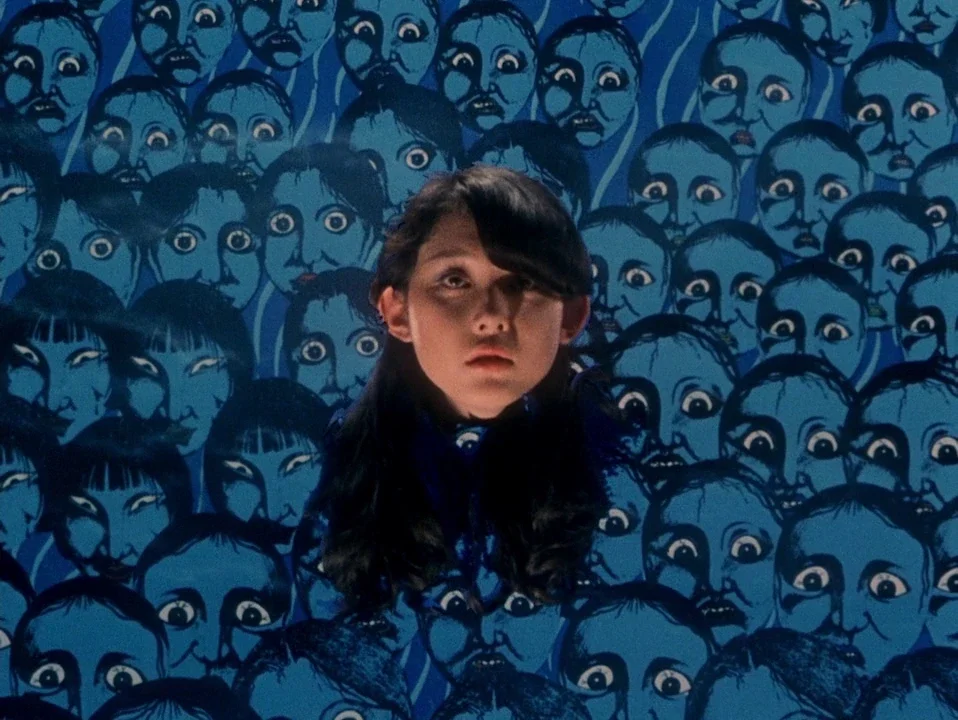
HAUSU│© 1977 Toho Co., Ltd.
This article contains spoilers for the movie HAUSU.
As the lights dimmed in the downstairs screen at London’s Prince Charles Cinema and the crowd began to settle into their seats, what was once an unintelligible wall of noise dissipated into snippets of conversations clearly too good to be cut short by movie-going decorum. And as the title screen – a sharp-toothed house with an ostentatiously gigantic red tongue splayed out before it – washed over the room, I snuck a glimpse at the now crimson-dyed faces around me: some looked expectant, while others sat there with knowing smiles, ready to succumb to the madness about to be laid out before them. We were, of course, about to watch, or rather, experience, Hausu.
Despite being from 1977, Obayashi Nobuhiko’s comedy horror has a freshness and willingness to confront the tropes of the genre that still feel revolutionary, both in spite of and because of the janky visuals. Its playful energy steamrolls through at a breakneck pace, while deeper questions of love, war and the pain of broken promises simmer in the background, driving the entire plot. This defiant spirit and uncategorisable uniqueness have been crucial in its transformation from a critically panned box-office sleeper hit to one of Japan’s most beloved and enduring cult-classic films.
Childish Nightmares
The genesis of Hausu, which follows the deceptively simple plot of seven middle-school girls as they are picked off one by one in a haunted house, was predictably unorthodox. For one, Obayashi did not follow a typical route to film directing. Prior to Hausu – his directorial debut – Obayashi directed a number of commercials for creative agencies like Dentsu, and his distinct style is already apparent in these.
For the textile and clothing company Renown, Obayashi shot a sexually charged montage of women fawning over lookalikes of stars like James Dean and Clark Gable in their signature outfits, while Tarzan swings through the set, all accompanied by an upbeat jingle and loud moans and groans. For a fragrance called Mandom, actor Charles Bronson rips his shirt off and douses himself in the fragrance, the camera revolving around him while his muscles bulge and contract. Interspersed are clips of Bronson in cowboy attire, riding a horse and gunslinging, while horses neigh and he ponders, ‘What is love? What is courage? What is kindness?’. As film director HiguchiNaofumi said in an interview, ‘all the commercials that made a strong impression on us . . . were all Obayashi’s work’.
Obayashi was significant in changing commercials from information dumps into mini-narratives, condensing and creating bite-sized drama around a product. This reputation as a director who could generate buzz, attention and revenue for film studios put him in good stead to direct what Toho Studios wanted: Japan’s answer to Jaws. Obayashi had no intention of producing a conventional blockbuster, however, and, inspired by conversations with his twelve-year-old daughter about her fears – which included classic horror tropes like mirror images that attacked their beholders and houses that ate people, as well as more quotidian worries such as fingers getting stuck between piano keys and the menacing aura of gigantic grandfather clocks – he developed the concept.
While Toho greenlit his idea, rules at the time meant that the film’s director had to be someone other than Obayashi, but after two years of searching, nobody wanted the job. Thus, Obayashi – after aggressively marketing the film himself through radio shows and a manga adaptation – was allowed to direct it and, in spite of Toho having no hopes for its success, it proved a hit among Japan’s young moviegoers searching for something they had never seen before.
The Plot Is Peripheral . . .
Hausu’s protagonists – all teenage girls – are at turning points in their lives: school’s out for summer, and they’re trying to decide what to do with their newfound time. They all have nicknames that, in typical fairy-tale style, distil their characters to the lowest common denominator – Angel (or Gorgeous, depending on the edition) is beautiful, Melody loves music, Prof is smart (and wears glasses!), Kung Fu is a martial-arts expert, Fantasy can’t help daydreaming, Mac (short for stomach) loves to eat, and Sweet is sweet.
We never learn the names of our Japanese Seven Dwarves, and Obayashi doesn’t want us to: these girls are symbols of idyllic childhood, an effect heightened by the fact that all their actors are novices. To add to this, the set design is intentionally over the top and artificial. The girls go to school in a palatial building, its quad towered over by a colossal European-style statue. The town they live in has singing cobblers and a mishmash of cultures living in harmony, adding their voices to the chorus. Even the home of our main character, Angel, is comically stunning. Despite a typical exterior, it’s lavishly decorated, and the balcony overlooks a blindingly golden perpetual sunset.
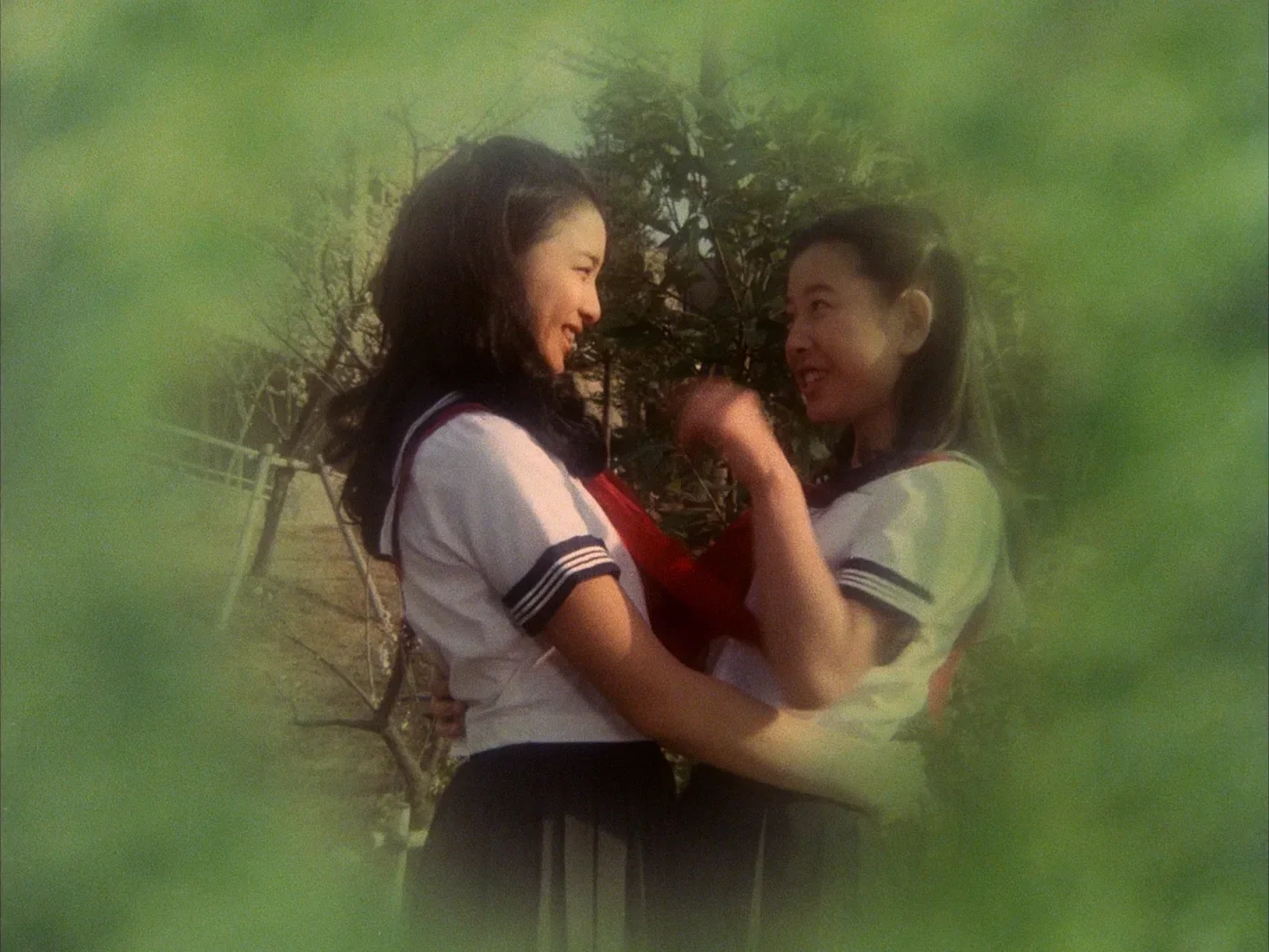
HAUSU│© 1977 Toho Co., Ltd.
This bliss is shattered, however, when Angel’s father – a collar-popping, pipe-smoking movie composer working with the likes of Sergio Leone – introduces her to his new partner and her new stepmother: a perpetually half-smiling woman with a scarf that billows gracefully, even when there’s no wind. He promised he would spend the summer with her, but this new relationship threatens their bond and Angel’s perception of her father’s loyalty to her real mother, who died some years before.
After crossing her father out of all the family photos, Angel contacts her reclusive aunt, who lives alone in a gigantic house in the countryside. As if by magic, a snow-white cat appears with a letter bearing her aunt’s invitation for her and her friends to stay over the summer. And so it begins.
What quickly becomes apparent is the uniqueness of Obayashi’s style. As the girls travel to the countryside in a Yellow Submarine-like montage, they sit on the shinkansen with nuns, European sailors and salarymen. They look out of the window at painted vistas and, once they get off, the idyllic background they are standing in front of is revealed to be an advert reflecting the Japanese National Railways’ 1970s ‘Discover Japan’ campaign.
Amid this visual comedy, the tone shifts when Angel tells the tragic story of her aunt losing her betrothed after he was conscripted into the Japanese air force during the Second World War. While she tells the story, the film becomes a film within a film that the characters ‘watch’ and comment upon, flickering between marriage and atomic-bomb explosions, creation and destruction, love and war. Through this breathlessly edited sequence, Hausu’s main themes become apparent, and any semblance of a categorisable film is thrown out of the shinkansen window.
As soon as they arrive at the cobwebbed mansion Angel’s aunt inhabits, everything feels wrong, and the aunt winks at us through the camera while the girls shriek and squeal as the house plays tricks on them. Brushing aside the creepiness that oozes from Minamida Yoko’s superb performance, the girls go about their day in a manner reminiscent of an advert for the Japanese inaka, complete with a well filled with cold water to keep watermelons cool, a firewood-heated traditional bath, and characters mopping sweat from their brows and sighing, ‘isn’t the countryside great?’, with visible contentment.
But soon enough, just as Obayashi’s daughter imagined, Mac gets eaten, Sweet gets swarmed by sentient futons, and Melody is consumed by the piano, while the remaining girls rationalise events as mere imagination. By the credits, Angel’s aunt – revealed to be her spirit, refusing to cross over because her long-dead lover promised to return – has inhabited Angel’s body and killed and eaten the other girls.
In the final, beautifully tragic moments of the film, Prof dissolves in the blood that floods the house, her serene, swimming form slowly twirling into nothingness, and Fantasy, true to her name, gives in to delusion and embraces Angel, who smiles knowingly at the camera and tells us that ‘The story of love must be told many times over, so that the spirit of love may live forever.’
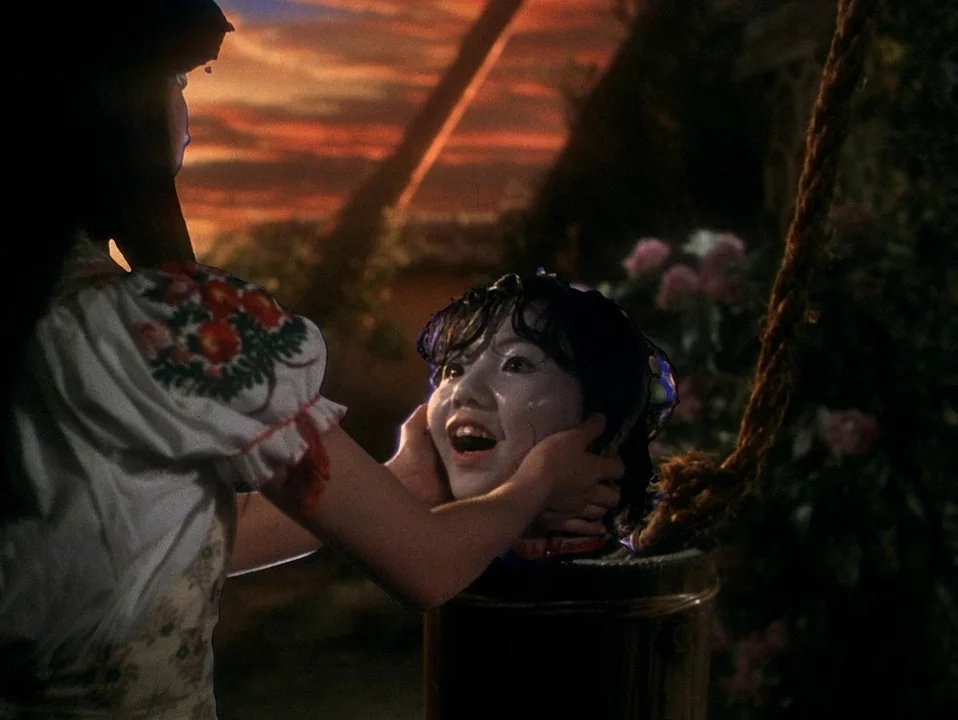
HAUSU│© 1977 Toho Co., Ltd.
. . . But What Does It Mean?
Although Hausu is a brief film at 88 minutes, any synopsis feels inadequate. Every scene is visually striking, packing so much into the frame, and the special effects have the quality of a child putting crayon to paper. The kung-fu segments show Kung Fu flying through the air with superhuman strength and speed while a jumpy bassline plays. The slapstick visual gags – like the stepmother’s perpetually billowing scarf and the cat footage being played and rewound to the beat of the music – reinforce the sense that Obayashi was having enormous fun.
Its clear artifice ensures that you never feel Obayashi is trying to convince you that any of this could happen in real life – something modern horror films could learn from. The soundtrack by Godiego floats above the carnage, and the leitmotif derived from the aunt’s musical box adds a deep melancholy even when the film is at its funniest.
More important than any synopsis is what underpins the violence, the humour and the teacher who, instead of rescuing the girls, embarks on a caper full of references to Japanese cinema, only to be turned into a literal bunch of bananas. Through this genre-blending pastiche, Obayashi expresses a clear desire to say something meaningful.
Born in Hiroshima in 1938, Obayashi experienced the war first-hand. His father served in the military, and the spectre of war hung over his entire career. Almost all of his films carry an anti-war message, and this, his first, is no exception. The aunt’s transformation into a vengeful spirit suggests that war does not end in victory or defeat: everyone touched by it carries it forward and is permanently altered.
This trauma extends to the next generation, symbolised by the seven protagonists. By consuming them and ultimately inhabiting Angel – now in traditional bridal attire – the aunt perpetuates the cycle of suffering. A generation that never knew war is forced to inherit its consequences.
Ongoing Legacy
Hausu still feels ahead of its time, and this, along with its enduring themes, is what allows audiences decades later to experience it in cinemas. Its deliberately artificial visuals and playful editing anticipate internet-era humour, while its emotional core remains strikingly sincere.
It is ironic that Hausu has eclipsed the other half of its original double bill – the romance Love in the Mud, which Toho expected to be the safer success. But it is no surprise that this strange, imaginative work continues to captivate audiences. Few films match its intensity, and it is unlikely that any ever will.
Trending articles



The Weeknd taps into his love for Tokyo.